The One
Will men with intensified visual perception
not be confused by the five colors and excessive ornamentation,
and be dazzled buy the brightness of
green and yellow, white and black?
Li Zhu was such a man.
Will men with extraordinary power of hearing
not be confused by the five notes
and the excessive use of the six tones,
which are produced by instruments of metal,
string, bamboo, bells and great tubes?
Shi Kuang was such a man.
Will men with excessive benevolence
promote virtue and not distort their nature
to acquire fame and renown,
inciting the world to strain after
the unattainable doctrines?
Zeng Shen and Shi Qua were such men.
Will men considerable talent in debating
not exhaust themselves
with useless words in seeking after temporary fame
by piling up arguments, distorting statements,
and indulging in the discussion on
“hard” and “white” or “identical” and “different”?
Yang Zhu and Mozi were such men.
In all these instances,
with their complex approaches,
people do not follow the right path in the world.
The right path is the one
in which we do not lose our inherent
given nature.
Hence conjunction of parts
should not be regarded as redundant
nor separation as unnecessary.
Zhuangzi by Zhuang Zhou trans. by Hyun Hochmann, Yang Guorong, Webbed Toes
We come to one more story with a point in chapter 8 which is entitled Webbed Toes. The very term evokes feelings of distaste as all of the time I am able to walk upright. Webbing for my toes would not help. The idea is strangely alien unless you happen to be a frog, or any other amphibian. Water and webbing go together. We continue in a chapter that shouts, Webbed Toes! at the reader.
Tomorrow I intend to present part 2 of the meditation in this wry chapter.
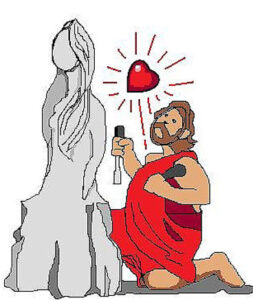 There’s a wide range of difference between individuals when you take humankind in general. The author gives examples of ability in which some are extraordinarily gifted. Zhuangzi writes that when one has a particular gift one usually becomes enamored with one’s faculty, like the Pygmalion story about a sculptor who fell in love with a statue he had carved. With the help of Aphrodite, the carved ivory becomes human, and the story continues… The artist that “falls” in love with his/her work.
Some favored by the good fortune of circumstance come by a great fortune. Is it possible, really to bend the trajectory of the future by expansive charity, the judicious application of funding to support medicine, to fund causes to tamp-down violence? How does this model of transformation work out?
Perhaps one is a powerful orator, a master of words, able to command the attention of everyone in a room? What if you had the mental acuity to push every button, verbally playing with persuasion, with feelings, like a maestro with a baton? You can make angels sing or cry! Are you thereby in a position to change things, to save the world? Or perhaps only to exhaust yourself?
The Taoist writer cautions, believing that one’s ability is that missing “key” to saving the world, or to save anyone else from their destiny is a mistake. Self-help author fame, forget about it! Achieving political renown!? Philanthropy? Forget about it.
Rather, there is a One Path, a way/Tao and that is to respect and abide in one’s uniquely personal nature. There is no single solution to the conundrum of human experience. Distraction causes us to overlook the personality that nature and fate has inscribed in us.
Do not lose your inherent nature! The way in which genetics and experience has made you is sufficient, without any of it being too much, or too little.
Part 2 for tomorrow.