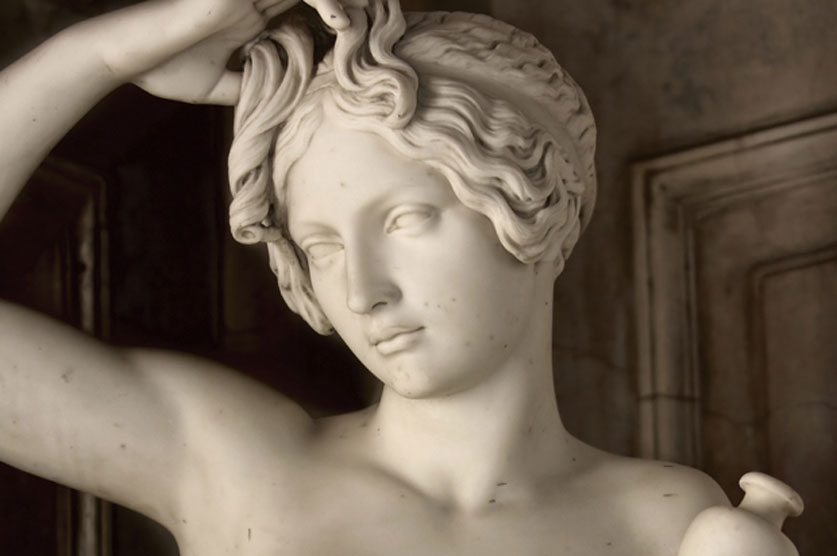
The Mirror
The sage understands the connections
between himself and others and how all things
constitute one body.
He does not know how this
is brought about:
it is due to his nature.
whether he is acted upon
or is acting,
he follows the direction of heaven;
Therefore people refer to him
as a sage.
If he were distressed about his knowledge
and the limitations of his action,
and if he were to halt,
how would he be a sage?
To one who is born beautiful
men/women serve as a mirror.
If ‹others› do not tell him,
he would not know that he is beautiful.
Whether he knows it or not,
or hears it or not,
his beauty always stays the same,
and the admiration of others
will also stay the same.
This is the course of nature.
Zhuangzi, trans. by Hyun Höchsmann and Yang Guorong, Book 25 Zeyang
Understanding the connections, insight into the role of others, the opinions, the type of pigeon-holing unavoidable in all of our relationships, – is a rare gift. Typically we are swept away in torrent of perception, stereotypical ways that others project a return-image of ourselves… To receive all of that at face value, as the default. This is an ill-advised way to live.
To be sage-like means to receive all of that with a grain-of-salt. Our first impressions of others, is mere surface, like the tip of an iceberg. Nevertheless we make a snap judgment, and all to often a “mind made up” endures. Like a grease stain on cloth.
The sage, which is an informal designation, lives day to day on a different basis. How does he or she do it? He/she is not sure how. He just knows there is no bright line of difference between the ugly and the beautiful, the soft and hard, or the bright and dark.
Convention’s mirror is a convenience that we all share.
But the direction of heaven, the course of nature is different.





2 thoughts on “The Mirror”
I believe we have two internal mirrors. One is colored by the remarks, the temperament, and the attitude of those who offer critiques and opinions of who we are and how we act. This is the mirror alluded to in your text above and it can indeed offer a very destructive reflection. A reflection skewed by the subjective notions of others.
There is also a second mirror. One which is seen and used all too infrequently, if ever. This mirror reflects our true inner selves, displaying how we are treating the world and those around us in as objective a manner as possible. It is the mirror of mindfulness. The Tao helps in wiping the grime of infectious inaccuracies off of this mirror, but we must first know that our mirror needs to be cleaned. Not an easy thing to remember to do.
You have offered a useful distinction. As to the inner mirror that reflects the degree of regard offered by the self to the self – one must clean one’s own mirror. Every day.